For many clubs, movable soccer goals are a practical necessity—but not all goals are created equal. Behind the lower upfront price of cheaper options are hidden costs that can seriously impact safety, performance, and long-term value.
On a community soccer field in regional New South Wales in 2003, a three-year-old girl was happily singing and dancing to her favourite Wiggles song when a large movable soccer goal toppled over, crushing and killing her.
ABC News later reported that the coroner, Carl Milovanovich said it was abundantly clear that the toddler’s death was a tragic and avoidable one. He recommended that portable goals like this that don’t meet existing safety guidelines be banned.
A few years earlier, a 10-year-old boy was killed at Bonnyrigg in south-west Sydney when portable goals fell on him.
Tragically, there have been at least five other deaths and numerous serious injuries in Australia from movable soccer goals. Internationally, the death toll is even higher. Sadly, the victims are often young children and teenagers with their whole lives in front of them.
THE MOVABLE SOCCER GOAL MANDATORY STANDARD
In an effort to prevent tragic accidents like these, a national mandatory safety standard for movable soccer goals was introduced by the Australian Government in 2010. Based on parts of the voluntary Australian standard AS 4866.1-2007, the mandatory standard applies to all freestanding, portable goals weighing 28kg or more.
Poor quality or poorly maintained movable soccer goals can cost more in the long run
MANDATORY STANDARD SETS A LOW BAR
The mandatory standard was introduced specifically to reduce injury and death caused by movable soccer goals tipping over.
The standard focuses on securing movable soccer goals rather than re-engineering them. Pretty much any movable soccer goal can be made to comply with the mandatory standard which mandates anchor points at either side of the rear ground bar and permanent warning labels on the underside of the crossbar and outside both goal posts.
The problem is that most accidents occur during informal use when large soccer goals aren’t secured, not organised matches.
Although the mandatory standard is certainly a move in the right direction, it relies entirely on goals being properly secured and falls short of imposing any requirements on unsecured goals.
John Cann, General Manager of Australia’s leading football goal post manufacturer Abel Sports noted that, “Good quality portable soccer goals are designed and engineered from the ground up so that they aren’t top-heavy and therefore will be less likely to topple over.” Design, engineering and materials all play a part. “Unlike cheaper alternatives, good quality movable goals are engineered with a full-sized rear ground bar so there is more weight close to the ground where it’s needed most for added support and stability. Geometry plays a part too. For maximum stability the design of the goals should ensure that the centre of gravity is as low to the ground as possible and positioned away from edges and toward the middle of a generous base of support. It’s fairly basic physics, but you’d be surprised how many goals there are out there that aren’t designed this way.”
OTHER HAZARDS
Besides the risks associated with large portable soccer goals tipping over, there are other hazards that the mandatory standard doesn’t cover.
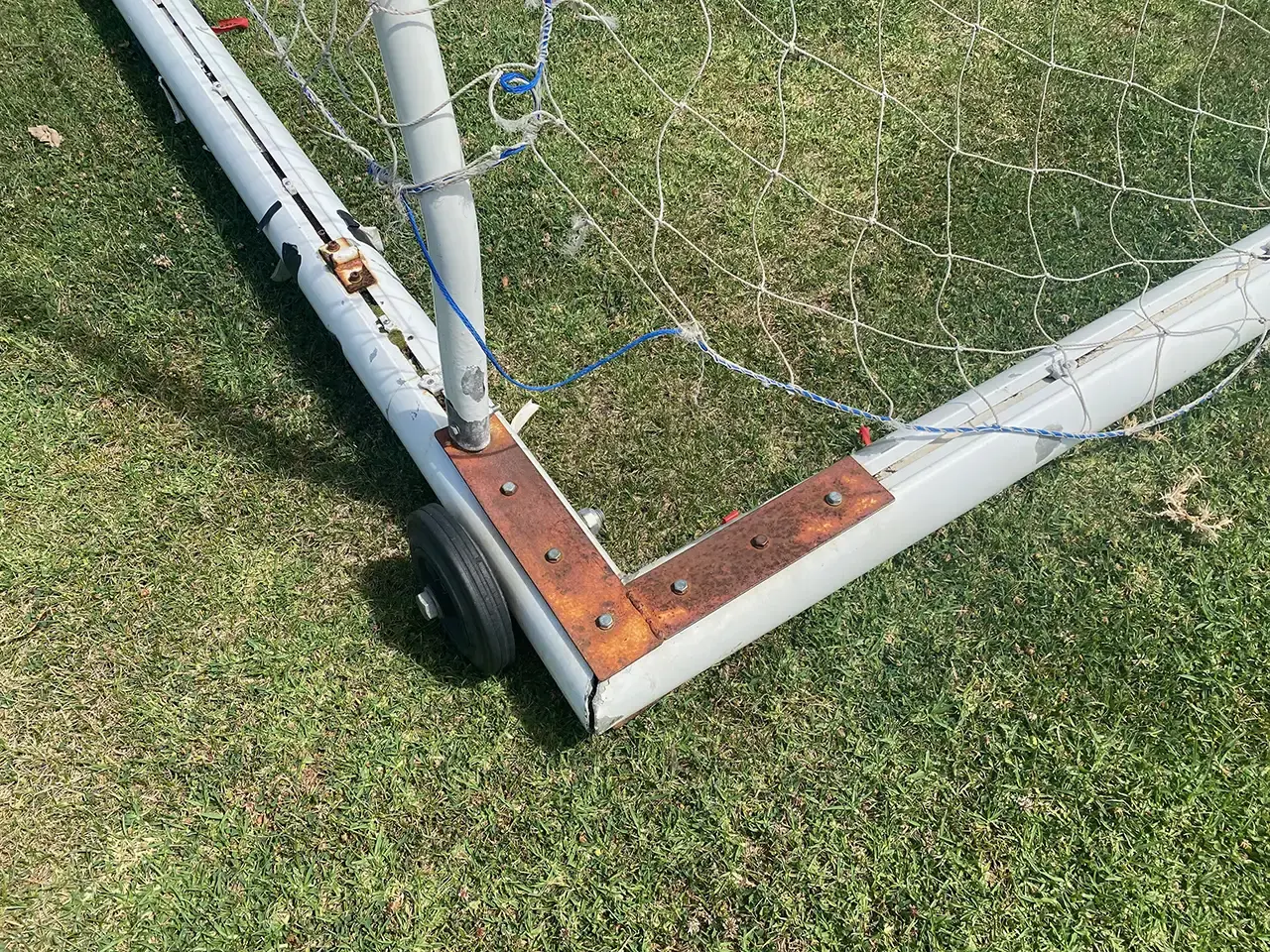
Low-quality goals use inferior materials like lower grade aluminium with thinner walls and weaker welds that are susceptible to rust. Over time this can cause frames to warp and joints to loosen, compromising the structural integrity of the goals.
Instead of a single piece crossbar, some lower quality goals use two shorter pieces of tubing joined in the middle. This makes shipping cheaper but reduces the strength of the crossbar which is a critical structural element of any large soccer goal.
“Some manufacturers also try to cut costs by using a smaller, lighter weight rear ground bar,” said Mr Cann. “This reduces the structural integrity of the goals and makes them more likely to tip over too.”
Forutnately, most of the time cost cutting measures like these don’t end with a tragedy. But it does mean goals don’t last as long. And sometimes, it can lead to catastrophic failure.
“Players aren’t meant to hang from the crossbar, we all should know that, but I’m amazed by how much it still happens,” said Mr Cann. “With unsecured goals this can lead to tragedy. But even with secured goals, I hate to think what could happen with someone swinging from a two-piece crossbar.”
Metal hooks used to secure nets to the football goal post have been responsible for some horrific injuries too. The Equipment and Facility Safety Policy of the Macquarie, Newcastle, and Hunter Valley Football Zone Association noted that a club player injured their knee on one of these hooks and a school student was seriously injured in a separate incident.
For added safety, higher end goals like those manufactured by Abel Sports have a Safe Net Clip Tracking System to prevent injuries and make setup quicker and easier.
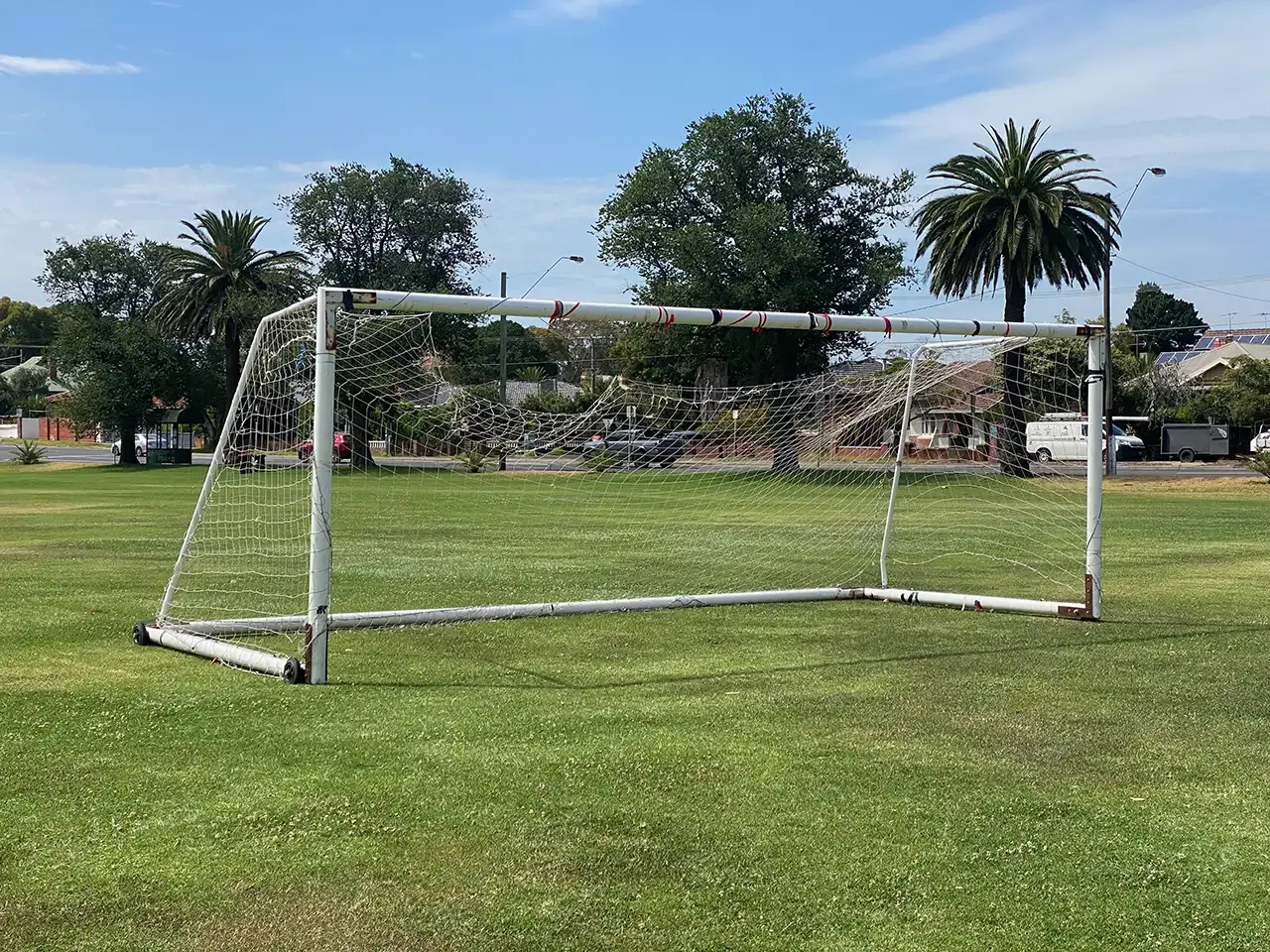
These goals have failed in multiple places including broken corners, rusted posts, torn net and missing wheels.
THE FINANCIAL COST
Low quality soccer goals aren't just a safety issue. They can end up costing cash-strapped community clubs more money in the long-run too.
"We know a lot of smaller clubs struggle with finances," said Mr Cann "what we try to get across is the total lifetime investment cost of their soccer goals.".
Lower-grade materials corrode, warp, and weaken faster—especially in Australia's harsh conditions. They require more frequent repairs and they don't' last as long. "The last thing the Technical Director of a soccer club wants to be doing is re-tightening fasteners, repainting posts, replacing components, and in extreme cases, welding broken corner joints."
"What seems like a saving upfront can quickly turn into a false economy if you have a replacement cycle every couple of years. If a lower quality goal costs 20% less, but lasts half as long, you aren't saving money. It's actually costing you more." said Mr Cann.
OTHER COSTS
The worst possible outcome is if a large soccer goal fails and injures someone. The financial implications for a community club can be dire, including legal claims, increased insurance premiums and disruption to normal operations.
Reputational damage is at stake too. Soccer clubs are expected to be safe. Parents expect it and players rely on it. When equipment fails it erodes confidence and damages trust.
After the tragic deaths in NSW, families were left asking how such preventable incidents could occur. One parent described the failures as "sloppiness, stupidity and slackness," emphasising that these accidents are entirely avoidable.
WHAT TO LOOK FOR
To the untrained eye, most soccer goals look the same. So how can you tell if a portable soccer goal is good quality or not?
Good quality movable soccer goals are built to meet and exceed all applicable safety standards They must include a secure anchoring system, use durable, corrosion-resistant materials, and be designed for stability and long-lasting performance.
Every movable soccer goal sold in Australia must meet the mandatory safe standard. Look for a large football goal that goes beyond this and complies with as many applicable Australian standards as possible as well as the FIFA and FFA compliance standards. Watch out for goals that only comply with one of the voluntary Australian standards or goals that comply with out of date or superseded standards. A good warranty is also a really strong indicator of quality and locally made goals tend to be better too.
| Category | Cheap/Low Quality Goals | High Quality Goals |
|---|---|---|
| Compliance | Mandatory Safety Standard | Mandatory Safety Standard, FIFA/FFA, and multiple Australian standards |
| Stability | Unstable/top-heavy | Engineered for added stability with lower centre of gravity |
| Materials | Thin aluminium, weak welds, low-grade fittings | High grade aluminium outer, reinforced steel inner core, strong welds |
| Construction | Crossbar constructed from multiple sections, smaller/light weight ground bar | Single piece crossbar and full-size rear ground bar |
| Durability | Prone to bending, rust and structural failure | Consistent performance over many seasons |
| Maintenance | Frequent repairs and adjustments | Minimal ongoing maintenance |
| Lifetime Value | Low upfront cost, higher long-term expense | Higher upfront cost, lower lifetime cost |
| Support | No after sales support | Local customer support with spare parts readily available |
| Warranty | Minimum 1 year mandated warranty under consumer law | Up to 5 Years |
Even though the upfront cost might be higher for quality goals, the total cost of ownership will be lower—and the safety benefits immeasurable.
And remember, always ensure moveable soccer goals are correctly anchored. Make sure everyone at your club knows the risks and understands what to do. No-one should ever climb, swing or play on a moveable soccer goal. Store them away safely when not in use, and if a goal does fail, don’t use it.